

The JOURNEY trial


About the trial
The JOURNEY trial will assess the safety and effectiveness of the J-Valve transfemoral (TF) system in patients with symptomatic, severe (grade 3 or 4), native AR and AR-dominant mixed aortic valve disease, who are judged by a multidisciplinary heart team to be at high risk for open SAVR.
Contact our Patient Support Center to find a participating hospital near you
Aortic regurgitation

Aortic regurgitation (AR) occurs in approximately 0.4% of all adults, in 1% of individuals aged 65-74 years and 2% of individuals over 70 years of age.1
Symptomatic patients with chronic severe AR have a poor prognosis and should therefore undergo surgical aortic valve replacement (SAVR) per current guidelines. The guideline directed indications for patients with Grade 3 or 4 AR include these symptomatic patients as well as asymptomatic patients with evidence of left ventricular remodeling, including dysfunction.2,3
Trial design

*Multimodality diagnostic assessment to determine AR severity by echocardiography and cardiac magnetic resonance (CMR) criteria for indeterminate AR
Eligibility criteria
- Symptomatic according to New York Heart Association (NYHA) functional class (FC) II or higher
- Severe AR, defined as follows, as assessed by Imaging Core Laboratory:
- A. Severe AR by Transthoracic Echocardiography (TTE) (grade 3 or 4)
- B. OR, if indeterminate AR by TTE, ANY ONE of the following:
- Cardiac magnetic resonance imaging (CMR)-derived aortic regurgitant fraction (RF) ≥43%
- CMR-derived RF ≥33% + left ventricular dilation (left ventricular end diastolic volume index (LVEDVi) >105 mL/m2 for men or LVEDVi > 96 mL/m2 for women)
- CMR-derived RF ≥33% + LV ejection fraction (LVEF) ≤55% or left-ventricular end-systolic volume index (LVESVi) ≥43 mL/m²
- Severe AR by Transesophageal Echocardiography (TEE) (grade 3 or 4)
- High risk for surgery as judged by a multi-disciplinary heart team*
- Suitable anatomy to accommodate the insertion, delivery, and deployment of the study devices
*Based on the American College of Cardiology (ACC)/American Heart Association (AHA) guidelines for management of patients with valvular heart disease
Full inclusion and exclusion criteria are detailed in the clinical protocol
Study device
Edwards J-Valve TAVR-AR System
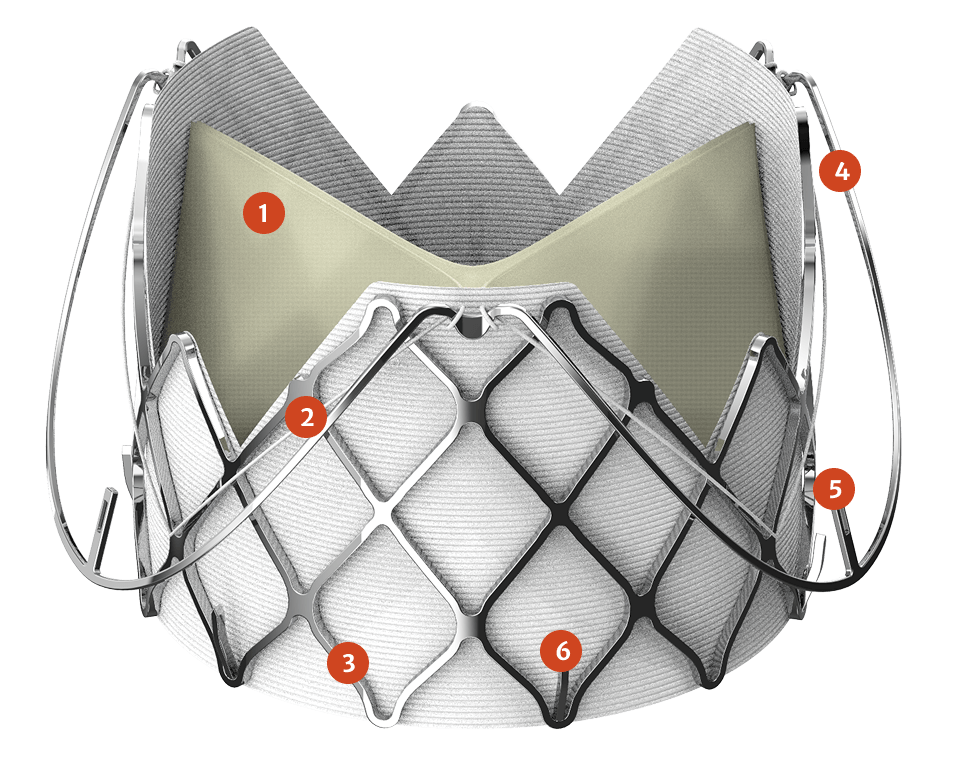
- 1Bovine pericardium leaflets
- 2Interconnecting suture
- 3Nitinol frame
- 4Anchor ring
- 5Latch (attachment to delivery device (x3))
- 6Grip feature (x6)
The J-Valve TAVR-AR system procedural animation

We're here for you
We are committed to providing the highest levels of customer service to help our patients improve their quality of life. For any questions, please contact the Edwards Patient Support Center.
For details about the trial, visit NCT06455787 at Clinical Trials.gov.
Give us a call
Send us an email
References
- Nkomo, V., Gardin, J., Skelton, T., Gottdiener, J., Scott CG, & Enriquez-Sarano, M. (2006, Sep 16). Burden of valvular heart diseases: a population-based study. Lancet, 1005-11. doi:10.1016/s0140-6736(06)69208-8
- Otto, C., Nishimura, R., & Bonow, R. (2021). 2020 ACC/AHA Guideline for Management of Patients with Valvular Heart Disease: A Report of the American College of Cardiology/American Heart Association Join Committee on Clinical Practice Guidelines. Circulation, 143(5), e72-e227. doi:10.1161/CIR.0000000000000923
- Vahanian , A., Beyersdorf , F., & Praz, F. (2021). 2021 ESC/EACTS Guidelines for the Management of Valvular Heart Disease: Developed by the Task Force for the Management of Valvular Heart Disease of the European Society of Cardiology (ESC) and the European Association for Cardio-Thoracic Surgery (EACTS). Eur Heart J, 43(7), 5610632. doi:10.1093/eurheartj/ehab395
CAUTION: Investigational device. Limited by Federal (United States) law to investigational use.